


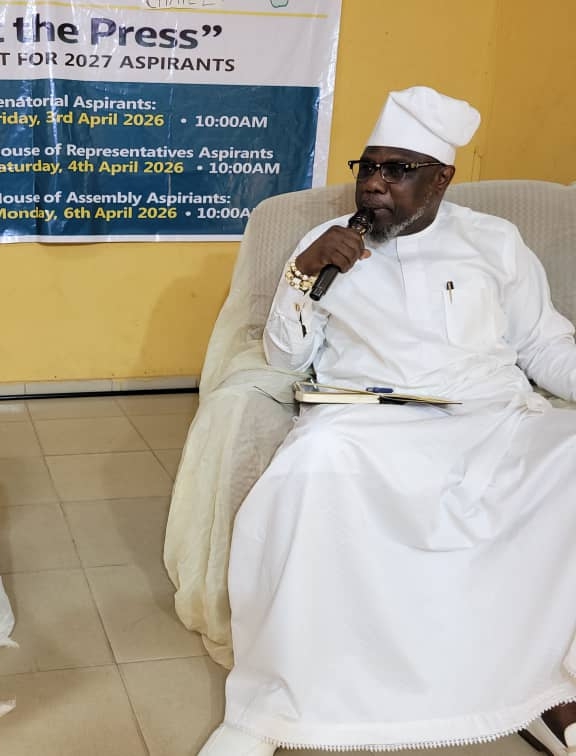
As political momentum steadily builds toward the 2027 general elections, the contest for representation in Ado-Odo/Ota Federal Constituency is taking a new shape — one defined not just by ambition, but by demonstrable impact. At the center of this evolving narrative is Olanrewaju Bashorun, widely known as Larrybash, whose entry into the race is increasingly seen as a fusion of grassroots credibility and forward-looking governance.
Long before formally declaring his ambition, Bashorun had built a reputation anchored in humanitarian service and community-driven interventions. Drawing from archival accounts and public engagements, he maintains that his aspiration is not a sudden political pursuit, but a natural progression of years of service.
“I have always been driven by a clear understanding of the needs of my people.”
Across Ado-Odo/Ota, his initiatives have reportedly touched multiple sectors — from financial assistance to healthcare access, job placements, and business support. Many small-scale entrepreneurs and artisans, particularly market women, have benefitted from interventions linked to his outreach platforms, including the widely referenced Seriki Foundation.
At a recent Meet-the-Press engagement, Bashorun delivered a statement that continues to resonate across political and media circles:
“I will not wait for government allocation before giving my people what they deserve.”
This assertion underscores a leadership philosophy rooted in immediacy and personal responsibility — a departure from the conventional dependence on federal disbursements. Observers interpret this as a signal of his readiness to deploy private-sector experience and networks in public service.
Identifying unemployment and economic hardship as the most pressing challenges facing the constituency, Bashorun outlined a multi-layered strategy focused on empowerment, skills, and sustainability.
He emphasized:
Revival of technical and vocational education
Expansion of youth empowerment programmes
Creation of structured employment pipelines
Support for small and medium-scale enterprises
Particularly, he lamented the decline of institutions like the Technical College in Igbesa, stressing that restoring such facilities would provide practical skills and reduce youth restiveness.
Bashorun’s vision extends beyond economic empowerment into social welfare. Among his proposed initiatives is a monthly food bank programme, designed to provide essential items such as rice and garri to vulnerable households.
He also pledged inclusive governance with targeted attention to:
Traditional institutions
Market women
Artisans
Indigent and underserved populations
This inclusive approach reflects his grassroots orientation — one shaped by years of direct interaction with diverse community groups.
A key pillar of his agenda is the creation of direct partnerships with industries in Ado-Odo/Ota and Igbesa. According to him, the constituency’s proximity to major economic infrastructure — including seaports, airports, and international borders — positions it as a natural hub for industrial growth.
Yet, he argues, this potential has remained largely untapped due to ineffective representation.
To address this, he proposed:
Hosting an industrial and investment summit
Leveraging national and international business networks
Connecting youths to existing industrial opportunities
On the issue of governance, Bashorun offered a critical perspective:
“The value of legislation lies not just in passing bills, but in their implementation.”
This stance reflects a broader critique of symbolic representation, emphasizing results-driven leadership that translates policy into tangible benefits.
As the Seriki of Ota, Bashorun occupies a revered traditional position — one he insists will complement, not conflict with, his legislative responsibilities.
“My traditional responsibilities will not hinder my service; they will strengthen my connection to the people.”
This dual identity — traditional leader and aspiring federal lawmaker — reinforces his claim of accessibility and accountability.
With the Independent National Electoral Commission outlining modalities such as direct primaries and consensus arrangements, the race toward 2027 is expected to intensify. Aspirants are already engaging stakeholders and consolidating grassroots support.
Within this dynamic landscape, Bashorun’s candidacy stands out for its combination of:
Established grassroots presence
Demonstrable humanitarian track record
Clear economic and social policy direction
Closing his engagement with a message of assurance, Bashorun declared:
“Give me the opportunity, and my people will never regret it.”
Whether this confidence will translate into electoral victory remains to be seen. However, one reality is clear — in the unfolding political story of Ado-Odo/Ota, Larrybash is not just participating; he is shaping the conversation.
