


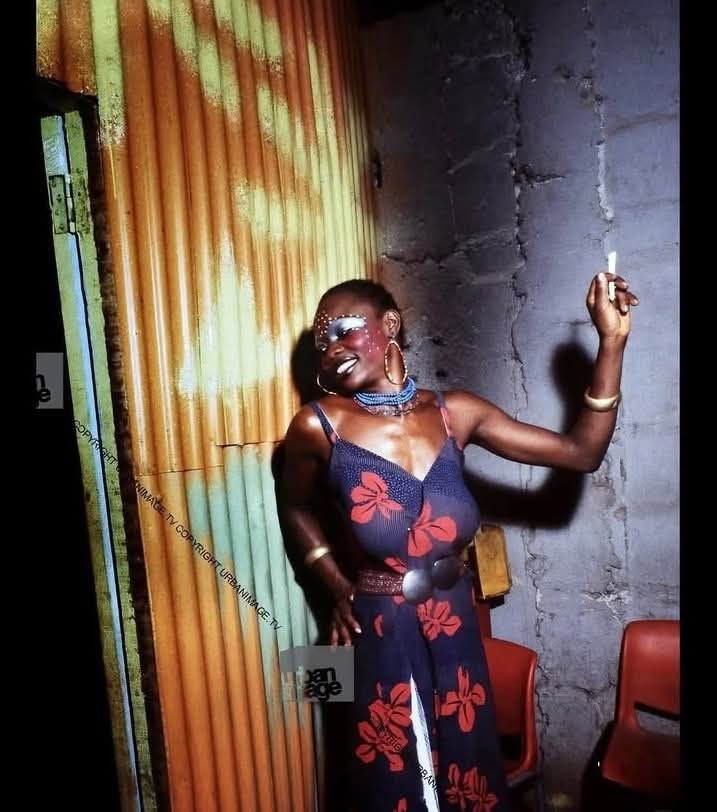
Fehintola Anikulapo-Kuti was one of the wives of the legendary Nigerian Afrobeat pioneer, Fela Anikulapo-Kuti. She was also the mother of Seun Kuti, who today carries on his father’s musical and political legacy. Though much of her personal story remains undocumented, Fehintola is remembered as an integral part of the vibrant community that shaped one of Africa’s most influential cultural movements.
Fehintola was among the twenty-seven women whom Fela married in a single traditional ceremony on February 20, 1978. The wedding was held at the Kalakuta Republic in Lagos, Nigeria, Fela’s self-declared commune that served as both home and headquarters for his band, Egypt 80. Many of these women were dancers, singers, and collaborators in Fela’s performances, embodying his vision of African identity, rebellion, and artistic freedom. Fehintola, like the others, lived within this complex social and creative community that blurred the lines between art, family, and activism.
She was frequently seen performing alongside Fela’s band, contributing to the theatrical and expressive dance routines that defined Afrobeat’s visual style. The famous photograph of Fehintola, taken in 1978 by British photographer Adrian Boot, captures her relaxed and confident presence at the Kalakuta Republic. The image, preserved in the Urban Image photo archive, remains one of the few public records of her life, reflecting the strength and individuality of the women who stood beside Fela during his years of political defiance and artistic revolution.
As the mother of Seun Kuti, Fehintola played a vital role in nurturing the next generation of Afrobeat. Seun has often paid tribute to her in interviews and on social media, describing her as a loving and strong woman who shaped his understanding of resilience and family. In one public tribute, he shared an old photo of her with the caption, “Miss you ma! Big boys cry too,” revealing the deep bond they shared and her enduring influence in his life.
Fehintola’s legacy extends beyond her connection to Fela. She represents the community of women who were more than just companions to the Afrobeat icon—they were collaborators, cultural custodians, and embodiments of a radical lifestyle that challenged Nigeria’s social conventions of the 1970s and 1980s. Through dance, music, and shared resistance, they helped sustain the creative energy that made Afrobeat not just a sound but a movement.
Although little is known about Fehintola’s early life, education, or later years, her memory lives on through her son and through the visual and oral histories of Kalakuta. Her story, like that of many women in Nigeria’s cultural history, is one of quiet power—woven into the larger narrative of artistic rebellion, community living, and the fight for social change that defined Fela’s world.
Sources:
Pulse Nigeria: “Afrobeat musician remembers mum with old photo” (2015)
Yorubaness.com.ng: “Why Fela Anikulapo Kuti Married 27 Women on 20 February 1978” (2022)
Biographical Legacy and Research Foundation (BLERF): “Fela Anikulapo Kuti Biography”
UrbanImage.tv: Adrian Boot Photography Archive (1978 Kalakuta Republic Collection)
