


…Initiative Targets Administrative Bottlenecks, Approval Delays and Improved Port Efficiency
The Nigeria Customs Service (NCS), Apapa Area Command, has intensified efforts to improve cargo clearance efficiency and eliminate administrative bottlenecks through a sensitisation programme on the Automated Overtime Cargo Clearance System.
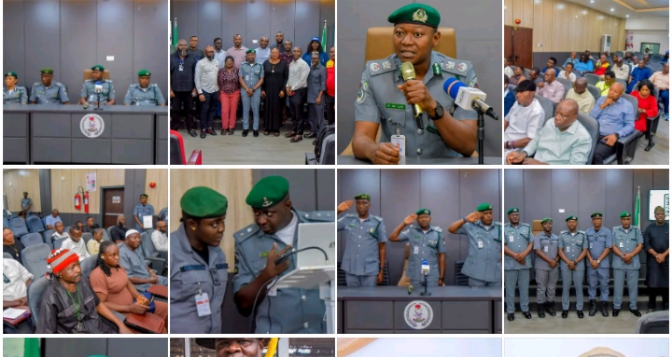
The programme, held in Apapa on Tuesday, November 3, 2026, was organised under the leadership of the Customs Area Controller (CAC), Apapa Area Command, Comptroller of Customs Murtala Mu’azu, to strengthen the capacity of Customs officers and deepen stakeholders’ understanding of the technology-driven clearance process.
The engagement brought together senior Customs officers and key maritime industry stakeholders, including consignees, customs brokers and other port operators, with the objective of addressing operational challenges associated with the former manual clearance procedure, reducing approval delays and promoting seamless port operations.
Speaking at the programme, Comptroller Mu’azu emphasised the importance of embracing automation as a practical solution to the administrative difficulties that previously characterised the processing and approval of overtime cargo clearance applications.
He explained that the former paper-based procedure involved several stages of documentation, compilation and referral to higher authorities for approval, a process that often created delays and inconsistencies in determining the appropriate clearance category for cargoes.
According to him, the manual process sometimes created discrepancies between the time cargo examination reports were compiled and when final decisions were eventually taken.
“The determination of the duration of stay of cargo, as well as the compilation and referral to headquarters, were all done manually. However, we realised that there were usually gaps in the process, particularly between the period when these compilations were made and when decisions were taken,” Mu’azu explained.
The Customs Area Controller noted that such administrative gaps could complicate clearance procedures, particularly when the status of a consignment changed while an approval request was still being processed.
He illustrated the challenge with instances where cargoes examined after 31 or 32 days could move into another regulatory category before the relevant authority concluded the approval process, thereby creating complications regarding the appropriate level of authorisation.
Mu’azu stated that the automated system would significantly reduce dependence on multiple physical submissions, repetitive documentation and prolonged administrative referrals.
He stressed that digitalisation would promote a more coordinated and transparent process, enabling Customs officers and relevant stakeholders to handle overtime cargo clearance applications with greater efficiency and improved accountability.
The CAC described the sensitisation programme as an important capacity-building initiative designed to ensure that officers understand the operational requirements of the system, particularly the procedures for validating applications and processing approval requests.
He further emphasised that the success of the initiative depended on the effective participation of Customs personnel and maritime stakeholders, urging participants to familiarise themselves with the platform and ensure its proper utilisation.
Mu’azu disclosed that the engagement would be extended to other port users to ensure wider awareness, effective adoption and improved understanding of the automated process across the maritime community.
He also assured participants that the programme’s facilitators and the Command’s Information and Communication Technology (ICT) team would remain available to provide technical support, clarification and necessary guidance to end-users encountering operational difficulties.
The initiative aligns with the broader digital transformation agenda of the Nigeria Customs Service, which introduced the Automated Overtime Cargo Clearance System to address longstanding challenges associated with abandoned cargoes, manual processing, port congestion and administrative delays.
Through the initiative, the Service seeks to strengthen transparency, improve operational efficiency, reduce unnecessary human intervention and facilitate legitimate trade in accordance with established Customs regulations.
The Apapa Area Command’s renewed emphasis on sensitisation and capacity development under Comptroller Mu’azu further underscores the importance of technology, stakeholder collaboration and institutional efficiency in building a more responsive and business-friendly port environment.
The development represents another step towards improving service delivery, accelerating cargo clearance and strengthening the contribution of the Apapa Port to Nigeria’s economic growth.
