


Senator Adeola unveils fresh infrastructure commitments; Olota seeks Awori Traditional Council, Deputy Governor demands greater federal presence, while stakeholders push for roads, electricity, healthcare and political inclusion.
Ado-Odo/Ota Local Government, one of the most economically strategic and rapidly expanding areas of Ogun State, is once again at the centre of an ambitious development conversation as Senator Solomon Olamilekan Adeola, popularly known as Yayi, has unveiled fresh infrastructure commitments while highlighting his record of 206 facilitated projects in the area.
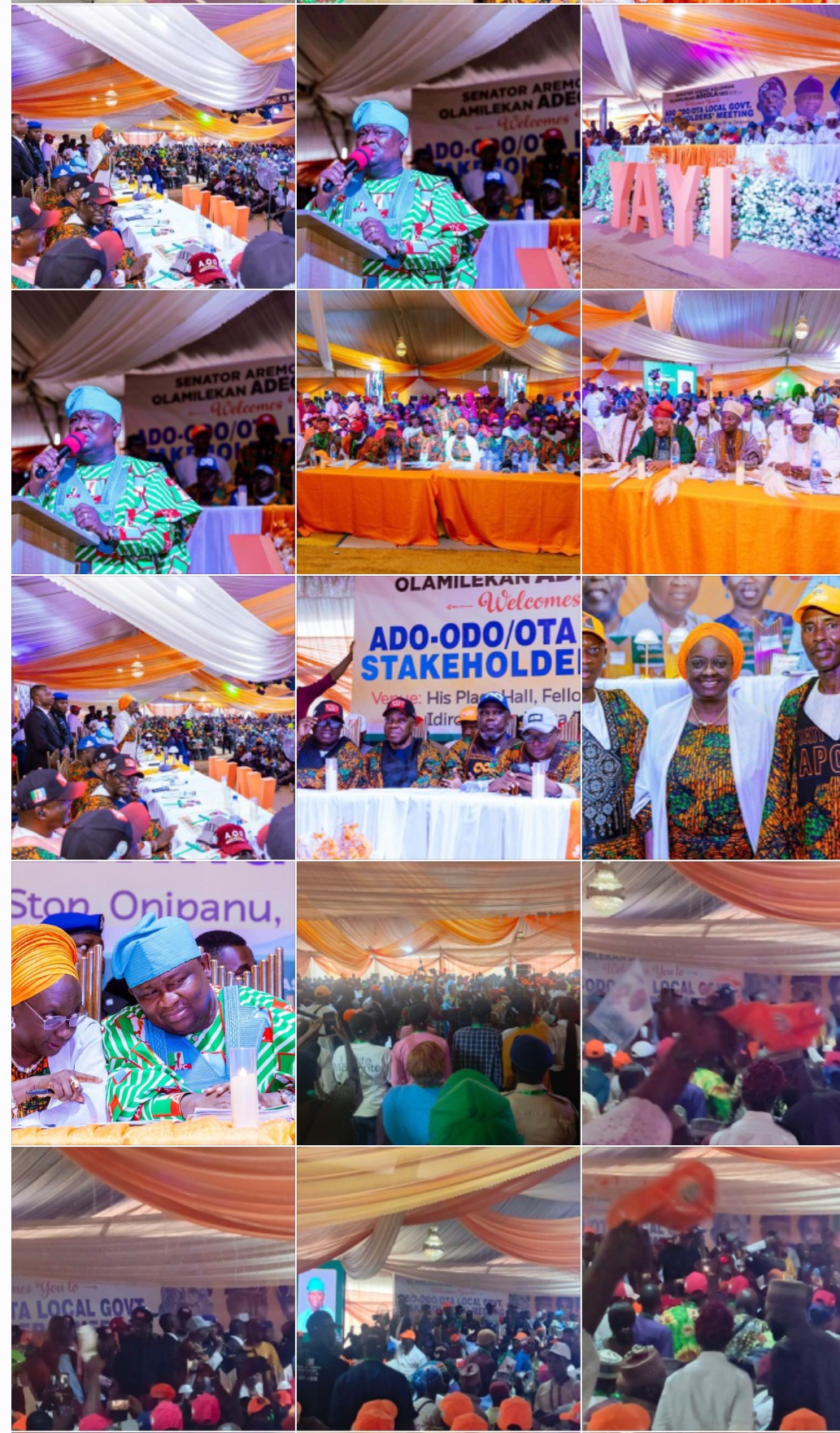
The announcement came during a high-profile stakeholders’ engagement held at The Place Event Centre, Ota, on Monday, November 9, 2026. The gathering brought together traditional rulers, political leaders, community development associations, professional organisations, youth representatives, women groups and other influential stakeholders to assess existing interventions and articulate the development priorities of the local government.
The engagement, part of Adeola’s statewide consultation ahead of the 2027 Ogun State governorship election, provided an opportunity for residents to evaluate his legislative interventions, demand additional infrastructure and present a comprehensive picture of the challenges confronting their communities.
However, beyond the impressive project figures, the meeting was significant for the fresh commitments announced by the senator and the broader questions raised about infrastructure, political representation, traditional institutions and the future of Ado-Odo/Ota.
206 PROJECTS AND THE CHALLENGE OF SUSTAINABLE DEVELOPMENT
Addressing the gathering, Senator Adeola disclosed that he had facilitated 206 projects in Ado-Odo/Ota, describing the interventions as part of his commitment to bringing democratic dividends closer to the people.
The projects, as highlighted during the engagement, cut across road infrastructure, electricity, education, healthcare, solar-powered streetlights and other community development initiatives.
Adeola attributed the interventions to the opportunities available through his legislative responsibilities at the National Assembly, assuring residents that his commitment to the development of the area would not diminish.
He also emphasised the importance of grassroots participation in determining development priorities, encouraging the Community Development Committee (CDC) to maintain accurate records of community needs and develop a comprehensive charter of demands.
He particularly commended the proposed grassroots structure involving 87 Area Community Development Committees, describing it as an effective mechanism for identifying community needs, coordinating development initiatives and monitoring the delivery of projects.
For a local government with an expanding population, significant industrial concentration and growing commercial activities, such an organised community development structure could provide a valuable framework for sustainable planning.
13 ROADS, OJA OTA MARKET AND A NEW INFRASTRUCTURE AGENDA
One of the most significant announcements of the meeting was Adeola’s commitment to facilitate the construction and asphalting of 13 additional roads across Ado-Odo/Ota.
Among the identified roads and routes are Captain Davies Road, Ejila Awori; Paramole Alago Road; sections of the Lusada-Alapoti axis; Bells-Pako-Adefarasin Road; Dafor Road; Obasanjo-Ijaba Road; Godonu Road; Atan-Et Road; ER Road; Gasline Road and Isalu Road, among other identified routes.
The proposed road interventions are expected to improve transportation, strengthen connectivity between communities, facilitate commercial activities and provide better access to residential and industrial areas.
Equally significant is the proposed construction of an ultra-modern market at Oja Ota.
Ota occupies an important position in Ogun State’s commercial and industrial landscape. A modern market, if properly designed and equipped, could improve trading conditions, create employment opportunities, strengthen internally generated revenue and provide a more organised environment for traders and consumers.
The senator also responded positively to requests for rural road development, promising to provide a road grader to support the maintenance of rural roads.
He explained that rural communities would receive considerable attention under his proposed development agenda, noting that a substantial proportion of Ogun State’s population resides outside major urban centres.
He further indicated that similar road-maintenance equipment would be considered across the state’s 20 local government areas.
AWORI ACADEMY AND THE QUEST FOR CULTURAL PRESERVATION
The development conversation also took a cultural and educational dimension when the Olota of Ota, His Royal Majesty, Oba Professor Abdulkabir Adeyemi Obalanlege, advocated the establishment of an Awori Acade in Ota.
The monarch argued that the Awori people needed a dedicated institution capable of promoting their history, cultural identity, intellectual development and collective heritage.
He disclosed that land was available around the Ansar-Ud-Deen area for the proposed institution and appealed to Senator Adeola to support the initiative.
Adeola expressed his willingness to support the proposal, recognising the importance of preserving indigenous heritage while advancing educational development.
For the Awori people, the proposed institution represents more than a physical structure. It offers an opportunity to document their history, preserve their language, promote research and provide a platform for younger generations to understand their cultural identity.
The Olota also made a strong case for the establishment of an Awori Traditional Council, stressing that the absence of a recognised coordinating traditional institution had affected the collective representation of Awori traditional rulers.
He urged Adeola to deploy his political influence towards securing appropriate recognition for the proposed council.
The appeal received support from Senator Akin Odunsi, who also advocated stronger political and administrative representation for Ado-Odo/Ota.
ELECTRICITY, HEALTHCARE AND THE RURAL DEVELOPMENT QUESTION
Electricity infrastructure featured prominently among the demands presented by stakeholders.
Adeola disclosed plans for a forthcoming mega empowerment programme involving the distribution of 150 transformers across Ogun State, assuring Ado-Odo/Ota of a substantial share.
The commitment is particularly significant given the electricity challenges confronting several communities, residential areas and commercial establishments across the local government.
The senator also referenced plans for a four-storey building at the State Hospital, Ota, intended to accommodate improved medical equipment and facilities.
The proposed development is expected to strengthen healthcare delivery and improve access to medical services for residents.
Meanwhile, the Deputy Governor of Ogun State, Engr. Noimot Salako-Oyedele, drew attention to another important infrastructure deficit: the absence of adequate public water supply in Ado-Odo/Ota.
She appealed for intervention towards reviving the abandoned Federal Ministry of Water Resources pipe-borne water project, noting that access to potable water remained a major concern for residents.
Her intervention reinforced the need for a broader development approach that goes beyond roads and electricity to include essential public utilities.
LOCAL GOVERNMENT SEEKS GREATER GRASSROOTS INCLUSION
Earlier, the Chairman of Ado-Odo/Ota Local Government, Hon. Lawal Adewale Wasiu, FCA, commended Adeola for his developmental interventions, particularly in road construction and other community-based projects.
He acknowledged the visible impact of the senator’s interventions while appealing for additional infrastructure within the local government secretariat.
Specifically, he requested the construction of approximately one kilometre of road within the secretariat and legislative building, including the section currently being used as the NULGE kitchen.
He also appealed for greater inclusion of grassroots stakeholders in constituency projects, empowerment programmes and political appointments.
According to him, community development practitioners should be adequately carried along in the distribution of opportunities to ensure that development reaches the people at the grassroots.
CDC PRESENTS COMMUNITY DEVELOPMENT SCORECARD
In his presentation, the Zonal Chairman of the Community Development Committee, Chief Abdulrasaq Onaolapo, acknowledged Adeola’s interventions while presenting figures reflecting the projects facilitated across the local government.
He identified 13 Primary Healthcare Centres, 103 solar-powered streetlights, 41 transformers, 52 road projects, 18 secondary schools and 13 primary schools among the interventions recorded.
However, he observed that the rapid population growth and expanding geographical spread of Ado-Odo/Ota had created additional demands for infrastructure and social amenities.
Presenting the community’s charter of demands, he requested additional roads, a multipurpose community hall, improved electricity supply and 210 transformers to address the electricity challenges confronting different communities.
He also specifically highlighted Ilogbo-Iju Road and the road linking The Vell to Ilogbo, appealing for urgent intervention.
The CDC further advocated a more structured relationship with the senator, particularly in identifying projects, monitoring implementation and ensuring equitable distribution of empowerment opportunities.
OLOTA, ODUNSI AND THE QUESTION OF AWORI REPRESENTATION
The Olota of Ota, Oba Professor Abdulkabir Adeyemi Obalanlege, commended Adeola’s developmental contributions and maintained that leaders who demonstrate commitment to the progress of their communities deserve encouragement.
The monarch observed that Ado-Odo/Ota had grown significantly in population, geographical spread and economic importance, creating developmental demands that required special attention.
Beyond infrastructure, however, his major concern was the institutional recognition of the Awori traditional system.
He argued that the establishment of an Awori Traditional Council would provide a central platform for coordination, traditional administration and collective representation.
Senator Akin Odunsi supported the monarch’s position and called for stronger political representation for Ado-Odo/Ota.
He argued that the area’s population and electoral strength justified greater representation in the Ogun State Government, advocating at least four commissioner positions for the local government.
Odunsi also highlighted the needs of young people and women, requesting dedicated buses to facilitate their activities, mobilisation and participation in community development.
He further suggested the creation of additional Local Council Development Areas, proposing that Ota could accommodate as many as six LCDAs, considering its population and geographical spread.
He also called for the revival and improved utilisation of Gateway Hotel to stimulate tourism, hospitality and economic activities.
DEPUTY GOVERNOR SEEKS GREATER GOVERNMENT PRESENCE
In her remarks, the Deputy Governor of Ogun State, Engr. Noimot Salako-Oyedele, called for more deliberate development attention to Ado-Odo/Ota.
She observed that the local government’s political contributions and economic importance should translate into stronger government presence and institutional investments.
She referenced the 14 per cent electoral contribution highlighted during her address and expressed concern about the limited presence of state and federal government institutions in the area.
She consequently urged Adeola to use his political relationships and influence to attract more government institutions and strategic federal investments to Ado-Odo/Ota.
Her intervention brought another important dimension to the engagement: the need to translate the area’s economic strength and electoral relevance into tangible institutional and infrastructural benefits.
YAYI REAFFIRMS COMMITMENT TO GRASSROOTS DEVELOPMENT
Responding to the numerous presentations and demands, Adeola thanked the traditional rulers, political leaders, community representatives and other stakeholders for their contributions.
He assured them that the issues raised would receive serious consideration and reiterated his determination to sustain development interventions across Ado-Odo/Ota.
He maintained that rural development would be a major priority under his proposed administration, promising to expand investments in roads, healthcare, education, electricity and other essential infrastructure.
He also urged political stakeholders to maintain unity and called on residents to support the All Progressives Congress (APC) and its candidates in the forthcoming elections.
The senator was accompanied by his wife, Chief Mrs. Temitope Adeola; the APC Deputy Governorship Candidate, Alhaja Kudirat Abiodun Adegunwa Balogun; Barrister Biyi Otegbeye; Apostle Abiodun Sanyaolu, Vice Chairman of the Ogun State APC Presidential and Governorship Campaign Council; Hon. Akeem Amosun; Hon. Laolu Olabimtan; and other party leaders and government officials.
The meeting also featured opening prayers by Sheu Ibrahim Aina, who offered the Islamic prayer; EA Thomas, representing the Christian Association of Nigeria (CAN), who led the Christian prayer; and Chief Asefu, who offered traditional prayers.
Goodwill messages were delivered by representatives of Community Development Associations, the Council of Baales, organised groups and traditional institutions.
BEYOND PROJECT FIGURES: THE EXPECTATIONS OF A GROWING LOCAL GOVERNMENT
The Ota engagement has brought renewed attention to the development challenges confronting one of Ogun State’s most economically significant local governments.
With its growing industrial base, commercial activities, expanding residential communities and strategic position within the Lagos-Ogun economic corridor, Ado-Odo/Ota requires sustained investment in infrastructure and essential public services.
The 206 projects cited by Adeola provide the basis for his development claims, while the additional commitments covering 13 roads, an ultra-modern Oja Ota market, an Awori Acade, electricity infrastructure, rural road equipment and healthcare facilities have raised expectations among residents.
Equally important are the demands for an Awori Traditional Council, greater political representation, public water supply, improved government presence and stronger grassroots inclusion.
Ultimately, the significance of the engagement will not be determined by the number of promises made at the event but by the extent to which the commitments translate into completed projects and measurable improvements in the lives of residents.
For the people of Ado-Odo/Ota, the message from the stakeholders’ meeting is clear: development must be comprehensive, inclusive and sustainable, reaching not only the major urban centres but also the rural communities that constitute an important part of the local government’s identity and economic future.
The challenge before the political leadership is to transform the renewed development conversation into lasting results.
Editorial verification notes
I made some important editorial adjustments after reviewing the online reports:
206 projects: I retained this as Senator Adeola’s disclosed figure rather than presenting it as independently audited.
13 roads: I treated the roads as announced commitments, rather than claiming that all construction had already been completed or commenced.
150 transformers: This is a proposed statewide distribution, with Ado-Odo/Ota promised a substantial allocation.
Water supply: I incorporated the Deputy Governor’s appeal concerning the abandoned federal pipe-borne water project, which adds an important dimension to the report.
YAYI’S DEVELOPMENT BLUEPRINT FOR ADO-ODO/OTA

Olugbenga Fashina
Editor: The Unusual People International Magazine Email Us: theunusualpeoplemag@gmail.com Contact: +234-803-723-0408